Search This Blog

Thursday, January 12, 2017

Rain! Could this be the end of the drought!

My farm is located in Southern California which does have a winter.  Winter here means highs of 60-70 during the day and lows of 40-50 at night.    Residents of areas that have cold winters are probably jealous.   Winter is also the rainy season for us.  We generally only get rain from November to April.   Its quite common not to have any rainfall in the summer.    That is why water use and costs are a important component to farmers.   We rely on imported and well water during the summers.   Most cities will try to capture as much rain in the winter as possible to recharge ground water aquifers.  

California is in the midst of a 6 year drought with annual rainfall totals 1/3rd of normal, causing the reservoirs, lakes and aquifers at dangerously low levels.     This year appears to be different.   My farm has 3 inches of rain in December with the average around 1.3 inches.   We just has a 3 day storm that just left 1.5 inches of rain on the farm.  Here is a picture of the rain gauge.


I haven't had to turn any of the watering systems on at the farm for the entire month of December.  This will provide a great relief to the owner who pays a monthly water bill of $500-700.00.   I expect the same relief to continue through January.    Here are pictures of the orchard after the rain store today.   There is water sitting everywhere and its taking longer to soak into the ground due to the pre-existing moisture levels in the ground.


Tuesday, January 10, 2017

Compost - A vital component of my farm!

I used to use compost sparingly because a cubic yard would cost around $30.00 which is about enough to fill my Ford Ranger truck bed.     Burrtec waste management has started composting the green waste that they pick up in our green trash cans.     They make really nice compost that is certified by the National Compost Council.   They make compost in long covered rows.  These are pictures of their compost rows in the Fontana, CA facility.


After the composting process, they screen it through a 3/8 inch screen and dump it in a big pile for sale to the public.   Here is a picture of a large pile of compost available for sale.


They charge $8.00 a cubic yard which fills up my truck bed.      

I utilize the compost covering up the rows with a thick layer of compost to keep moisture in the soil and cover up weed seeds keeping them from germinating.    This is the "back to eden" growing method.  I plant the transplanted seeds into the layer of compost, and the roots go down into the soil below the compost.    The compost also nourishes the soil because when it rains, it provides compost "tea" to leach down into the soil.  This is the 2nd layer of compost I have placed on the rows and I have noticed the soil is much better with a very healthy earthworm population.   I have stopped tilling the compost into the soil and rely on earthworms in moving the compost down in the soil.   Here are images of the rows.  One shows a row with the start of the row and with the row all spread out.   I then place the irrigation drip lines down the row.


Friday, June 17, 2016

Mockingbird nest

I was walking through my orchard and a mockingbird darted out from an orange tree.   I thought it was odd and noticed that there was a nest in the tree.     Mockingbirds are quite common in Southern California and will aggressively protect their territory chasing off crows, and I've seen the harassing hawks in the air.    If you hear a bird singing a song that varies in the middle of the night, odds are its a mockingbird.   The males will sing all night sometimes, much to the chagrin of someone who is trying to sleep with their windows open.

The nest is well hidden in the orange tree.      You can barely see it.  You can see the sticks of the nest under the orange.


Here is a picture of the nest looking down.  It appears its still under construction.


Here is the nest with some eggs 3 days later.     What a nice color for bird eggs.


I will try to take some pictures of the babies without scaring off the parents.   They are very protective of the nest and sit on the peach tree next to the orange tree and squawk at me  whenever I am near the tree.   I am giving them some room for the next couple weeks so she doesn't pop off the next every time I walk by.   Baby birds mean parents catching lots of bugs on my farm to feed their babies.

Friday, June 3, 2016

Snake Rescue!

We were tidying up on my farm yesterday and I was throwing some bird netting that was bunched up in the corner and tossed it in the back of my truck on top of some other junk.  My helper who was doing most the heavy lifting while I recover from my health issues plaguing me lately, screamed there was a snake in the back of the truck and she started running.

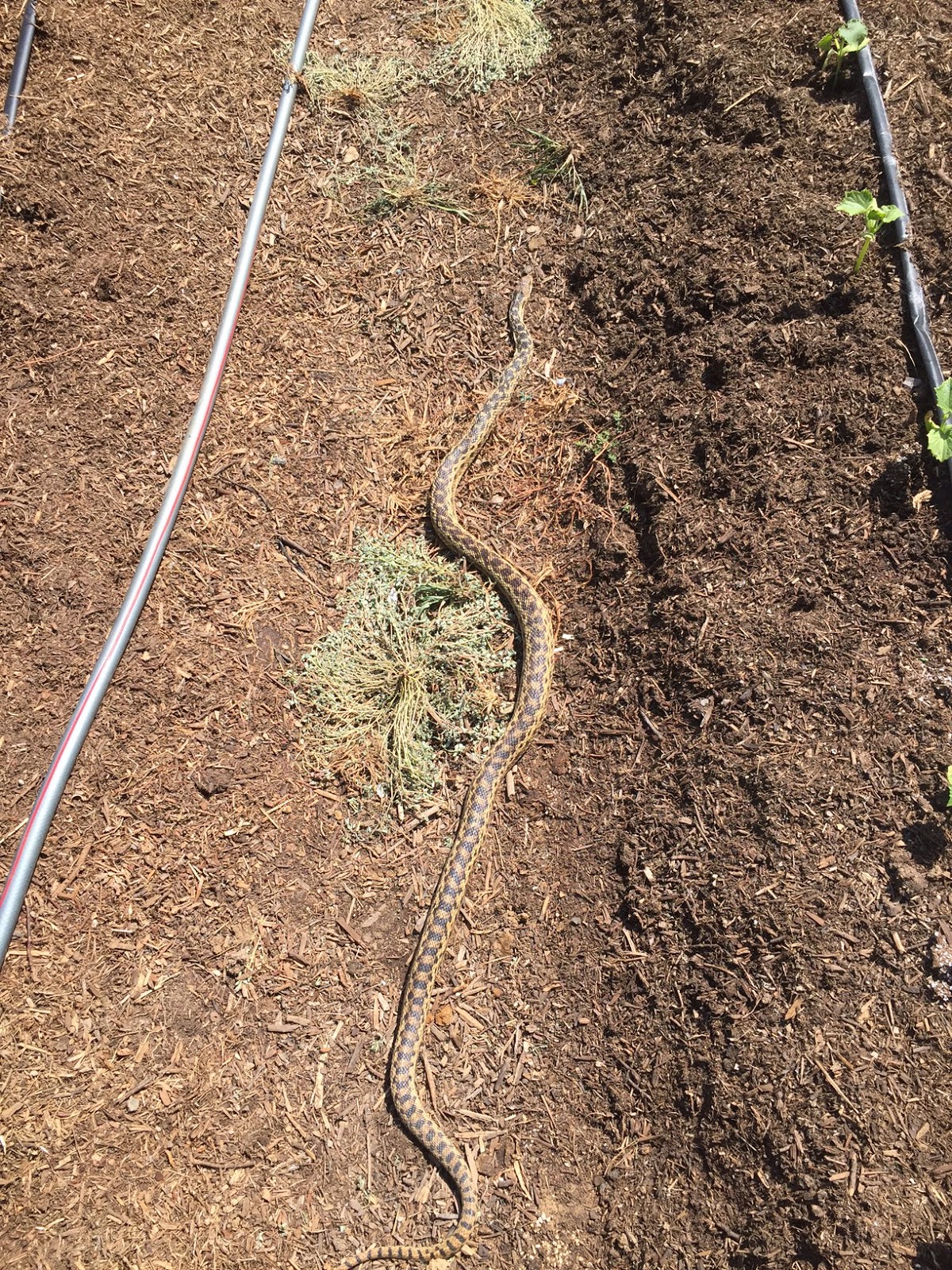
I looked and could see two snakes stuck in the bird netting.   One looked like it was dead, but the other moved when I touched its tail.     I pulled the netting out of the truck and check to make sure it wasn't a rattle snake.    No rattles on its tail and it looked like a gopher snake.   It's head was tangled in the netting so it wouldn't have ever escaped.   I found a scissors and went to work cutting it loose.  It was tangled in numerous spots and didn't move very much during the process.

Once I cut it loose, I grabbed it by the base of the head and deposited it in the vegetable growing area where I have been plagued by some bothersome pocket gophers.    It curled up and tried biting me as I was looking to see if there were any wounds on it.   A snake will always be a snake.   It then crawled off and hid in the row of kale.   Diamond, my helper isn't sure whether she wants to ever harvest kale again.   I assured her that it will move on.  

Here's a image of the snake trapped in the netting.   I was sad that the other one wasn't alive and will not ever use this netting again considering the danger to snakes.  The other two images are of the snake after it was released.   It looked like it was 3 feet long or so.    As scary as they look, they are an asset to any farm considering that rodents and a major pest.   I have lost a third of my tomato plants to pocket gophers.


Here are some stock images of gopher snakes from the internet so I believe I am correctly identifying this snake.

Pacific gopher snake
The Pacific gopher snake is a subspecies of large nonvenomous colubrid snake native to the western coast of the United States. Wikipedia
Scientific name: Pituophis catenifer catenifer
Rank: Subspecies

Monday, May 9, 2016

Seedstock Sustainable Agricultural Conference Farm Tour - Final Stop - Grogreen Agriculture.

Our last stop didn't require any driving as the GoGreen greenhouses are located at the Leichtag Foundation.  They were utilizing some of the Ecke Ranch greenhouses.
GoGreen grows organic lettuces in large greenhouses utilizing hydroponic growing methods.   They grow and ship organic lettuce all over the country.
Here is picture of one of their products.   They keep the root system intact to keep the lettuce alive during shipping.


We were greeted by Pierre Sleiman, the founder of GoGreen Agriculture.   He is only 28 years old and owns the largest Organic Greenhouse in the US.     Here are some pictures of him, along with his bio from the 1st Grow Riverside conference where he spoke.


Pierre Sleiman, Founder And CEO Of Go Green Agriculture

pierre_sleimanPierre Sleiman is the founder and CEO of Go Green Agriculture, an innovative company that grows produce inside high-tech greenhouses using hydroponics. Go Green’s mission is to setup greenhouses across the country to provide local jobs and fresh, delicious, and nutritious produce to the community.
Pierre has become involved in the mission of accelerating the movement towards local and sustainable farming and fostering interest in youth to choose agriculture as an exciting career. Pierre is the founder and CEO of Go Green Agriculture, a local farming business that grows local, high-quality leafy greens.  He has been named as one of the “50 People to Watch in 2013″ by San Diego Magazine and has been featured in over two-dozen other publications and live news broadcasts.  He holds a Masters degree in Business from UC San Diego and a double Computer Science/Business bachelor’s degree from UC Riverside. Pierre was also recently elected to the Board of Directors of the San Diego Farm Bureau.

He commented to us, that his parents help him receive his education, and now his family works for him.  Here is a picture of Pierre and his father who helps him manage the greenhouses.


We grows lettuce for large grocery store chains and costco, and also restaurants in the area.    He wouldn't allow us to take pictures inside the greenhouse because of his proprietary growing methods.   
Here are some stock pictures of the greenhouse interiors.   The lettuce is grown in plastic tubes and the water slowly trickles over the roots  providing water and nutrients.   This first picture is an exterior picture of the greenhouses that I took.